
If your pool has turned green sometime in the last few weeks, you're far from the only Phoenix homeowner dealing with it. Between weeks of monsoon rain, blowing dust, and a summer of relentless heat stress, a lot of pools have quietly slipped out of balance this season. Once a pool tips into green, it's a different problem than the algae spots you might be used to treating, and a real green pool recovery in Phoenix takes more than a bag of shock.
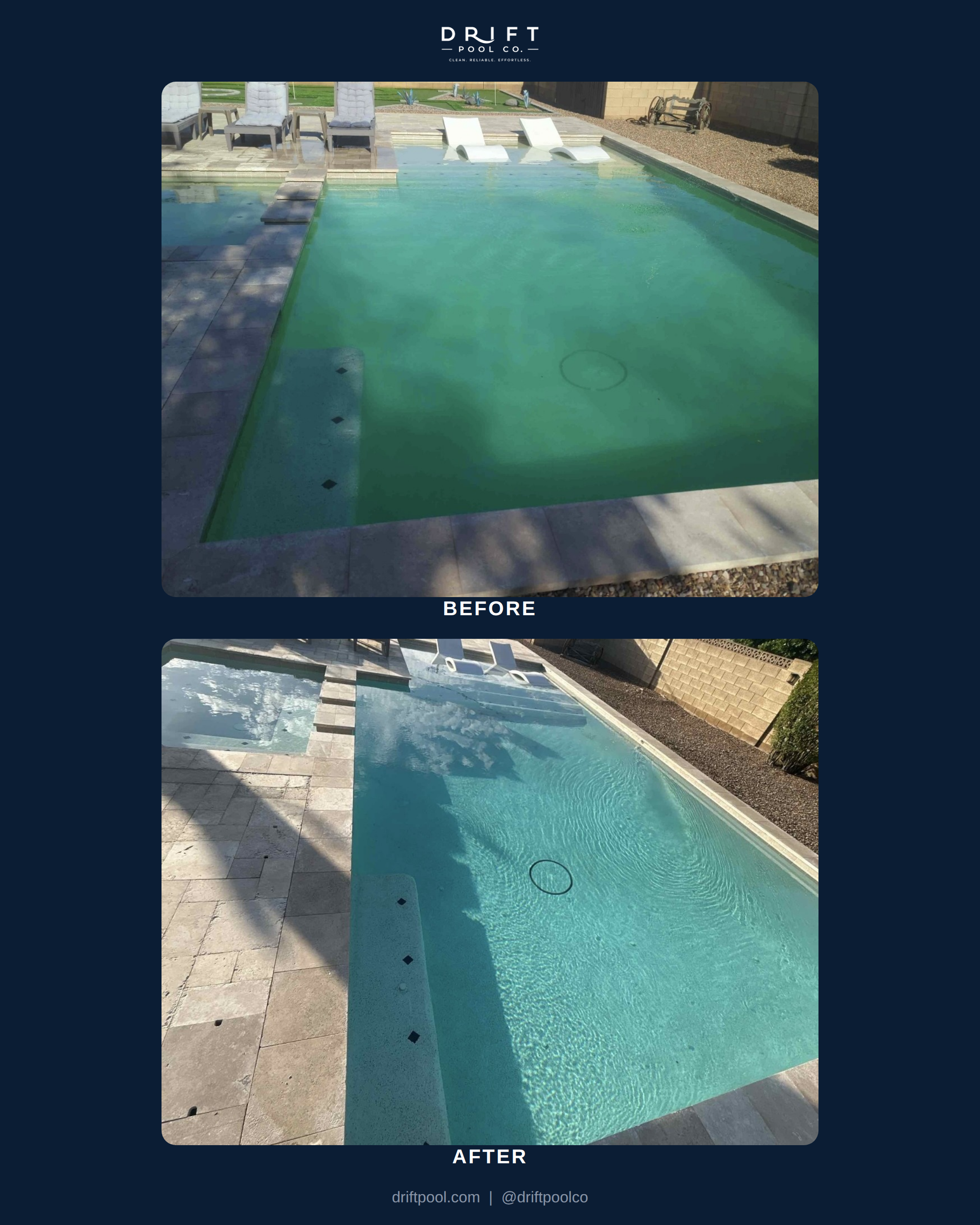
Why pools go green after a season like this one
Green water isn't usually caused by one bad day. It's the buildup of several stressors hitting a pool at once over weeks or months.
- Repeated rain dilution. Every storm this monsoon season diluted chemical levels a little more. If a pool wasn't retested and rebalanced after each one, those small dips add up.
- Heat-driven chlorine demand. Arizona's extended heat stretches burn through chlorine fast. A pool that fell behind on dosing during peak heat had less protection exactly when algae had the best conditions to grow.
- Dust and debris runoff. Wind ahead of monsoon storms carries dust and organic material into pools, adding nutrients that feed algae once chlorine levels dip.
- Missed maintenance windows. Life happens. A vacation, a busy stretch, a storm that made it inconvenient to get outside and test the water. A few missed days is often all it takes for algae to take hold.
Why a regular shock treatment usually isn't enough
Once a pool has fully turned green, the algae bloom is often big enough that a standard shock dose gets used up almost immediately without making a visible dent. This is the mistake a lot of DIY owners run into. They add more chlorine, see no real change, and add even more, without dealing with the amount of organic material actually in the water.
A true green pool recovery isn't a bigger version of routine maintenance. It's a structured process.
What a real green pool recovery in Phoenix looks like
- Assess the water first. Before adding anything, test to understand exactly what's out of balance: pH, alkalinity, and how far chlorine demand has fallen behind.
- Filter continuously. The filtration system needs to run around the clock to physically remove dead algae and debris as chemicals do their work. Skipping this is one of the most common reasons a "fix" doesn't hold.
- Shock at the right dose, then follow through. A green pool typically needs a much higher, carefully calculated shock dose than routine maintenance, followed by monitoring and adjustment over the next day or two.
- Brush and vacuum as it clears. As chlorine breaks down the algae, dead material settles. It needs to be brushed off surfaces and vacuumed out, not left to filter out on its own over days.
- Re-test and stabilize. Once the water clears, it still needs rebalancing. A pool that just went through a recovery is more volatile than one that's been steadily maintained, so it needs closer attention for the next week or two.
How long it actually takes
Done correctly, most green pool recoveries in Arizona go from fully green to swimmable within about 48 hours. That depends on how severe the bloom is and the size of the pool, but it's a realistic target for most residential pools when the process is followed properly rather than rushed or under-dosed.
If your pool took a hit this season, you're not behind
With this season's mix of extended heat and a late monsoon push, more pools than usual are dealing with exactly this right now. It's not a sign you did something wrong. It's been a hard season on Arizona pools.
We handle green-to-clean recoveries regularly
Drift Pool Co. runs full recovery processes for pools across the Phoenix area, not just spot treatments. If your pool has gone green, we can typically get it back to clean and swimmable within 48 hours. Want to see more real results first? Check out our before & after gallery.
Pool gone green? Let's get it back.
Book a Green Pool Recovery